
Showing posts with label NEWS. Show all posts
Showing posts with label NEWS. Show all posts
Thursday, May 30, 2013
Bill Gates still washes the dishes every night
No comments:
Labels:
NEWS,
TECH WORLD,
TechLife,
TECHNOLOGY,
WORLD
During his visit to Australia, the U.S. billionaire Bill Gates leads the world's richest, but he still washes the dishes every night.

In an interview with ABC, when asked why he had all 10 million show, Bill Gates says he does not want too much money for their children because they want to "have the freedom to choose what we want to do in life."
The billionaire said that leaving too much money for the children of only negative rather than the positive effects. "I believe that a child should grow up knowing that he must find a way to have a job and money. And you will not be able to understand that all of a sudden there is money that the desired improvements" - Bill Gates said.
"I lost consciousness many things in life. I was weeding the garden in a long period of time - Bill Gates is a joke - I've forgotten how it works. But I always wash the dishes every night. There is much work to maintain." Bill Gates said.


Monday, February 25, 2013
iPhone Mini reportedly launching this summer
No comments:
Labels:
MAC PRODUCTS,
NEWS,
TECH WORLD,
TechLife

The key to big markets like China and Brazil is a smaller, cheaper iPhone
A smaller iPhone may be joined by an iPad refresh.
The next device from Apple is rumored to be the iPhone Mini, a smaller - and more importantly cheaper - version of its smartphone, and the release date may be in the summer.
There are plenty of reasons why Apple needs to start making the cheaper iPhone Mini, and the Morgan Stanley managing director of the PC hardware industry, Katy Huberty, points that out after meeting with Apple Chief Financial Officer Peter Oppenheimer.
Emerging markets like China and Brazil have snapped up the iPad Mini, according to her comments picked up by CNET.
"iPad Mini is expanding Apple's customer base with 50 [percent] of purchases in China/Brazil representing new customers to the ecosystem," said Huberty.
Likewise, Chinese consumers are showing signs that they're willing to buy into the latest models of the iPhone instead of the smartphone's older generations.
Preparing for expanding markets as well as existing ones, she anticipates that new carrier partnerships will take place in Q2 2014 with NTT Docomo, T-Mobile, and China Mobile.
All Quiet on the Western Front
Outside of those emerging markets, Huberty notes that Apple's everyday consumers have been buying older versions of the iPhone.
"iPhone 4 demand surprised to the upside in the December quarter," she said.
She didn't speculate whether the reason for this is due to the lower price of the iPhone 4 and iPhone 4S or the lack of innovation in the iPhone 5.
In addition to saying that the iPhone Mini could launch in the summer, Huberty said that she expects that the iPad could be refreshed in the middle of the year.
I'm no analyst, but I think summer and middle of the year might happen at the same time.
Either way, rumors suggest that an iPad Mini 2 will roll out with a Retina display, and that iPad 5 will be completely redesigned.
Via CNET
Monday, January 21, 2013
Obama became the first president sworn in four times
No comments:
Labels:
NEWS,
TECH WORLD,
TechLife,
WORLD
When the oath of office at noon on January 21st (U.S.), Obama will become the first president in the history of this country sworn to four times for the second term.

Obama was sworn in before Judge John Roberts in the Green Room of the White House on yesterday January 20th, 2013.
President Barack Obama was officially sworn in for a second term on Sunday, in a brief ceremony held in the Green Room at the White House. Supreme Court Chief Justice John Roberts has presided over the oath as required by the U.S. constitution. According to information from the White House, First Lady Michelle Obama, daughters Sasha and Malia attended this oath.
"He has done," President Obama told the girls after the oath of office.
Obama, in fact this is the third time he was sworn. In celebration of his historic inauguration on January 20th, 2009, Judge Roberts have read upside oath, so Obama must be sworn in the next day.
The inauguration ceremony ever done on 20/1, the first official day of his presidency. But because 20 this year falls on a Sunday, so public inauguration ceremony was held on January 21st.
So when President Obama was sworn in ceremony today, before an estimated 800,000 people flocked to the National Mall national park, it will be Obama's fourth oath.
According to ABC News, President Franklin Roosevelt was also sworn in four times, but because he was elected four times.
And in the forthcoming oath, Roberts and Obama certainly not going to happen any errors. After the presidential election on 6/11 "two men exchanged a copy of the oath, each word correctly, dots and place emphasis in word reading sworn 35", an official organization inauguration said.
Thursday, December 27, 2012
Facebook CEO's sister loss control on Facebook!
No comments:
Labels:
FACEBOOK,
NEWS,
TECH WORLD
The Facebook CEO's sister is peeved that a photo she thought she'd posted privately is exposed publicly. It's quite a photo.
It's easy to have sympathy for those who have been misled by
Facebook's ever-morphing privacy controls. One should therefore have
additional sympathy when the person led astray is a former director of
Facebook and enjoys the name Zuckerberg.
Randi Zuckerberg thought she had posted a picture to be only seen by
her friends. Suddenly, it was there for all to see. Yes, all. The world.
The whole misanthropic, green-eyed human race.

Oh, Lordy. Let's discuss decency.
(Credit:
Screenshot by Chris Matyszczyk/CNET)
As ReadWriteWeb's Dan Lyons icily fulminates,
it seems that one of her sister's friends saw the picture, assumed it
was for public viewing and -- because of its profoundly fascinating
nature -- tweeted it down the Styx to public hell.
You'll be wondering about the picture. Well, it shows several members
of the Zuckerberg family standing around the kitchen, staring into
their cellphones and seeming astoundingly happy.
You might imagine that Randi Zuckerberg felt this was not the right message to be sending to the world.
Happy families at this time of year can be disturbing sights,
encouraging onlookers to wonder what lurks beneath those open mouths and
exposed teeth.

Yes, and do it publicly.
(Credit:
Screenshot by Chris Matyszczyk/CNET)
People will wonder what gifts these people bought each other and why
the boy with the very pale face and the hoodie is leaning smugly against
the kitchen cabinets.
Zuckerberg, however, leaped onto Twitter
to explain her pain: "Digital etiquette: always ask permission before
posting a friend's photo publicly. It's not about privacy settings, it's
about human decency."
Oh, but this only led to her receiving little lectures -- not exclusively about human decency, oddly enough.
Media Bistro wondered whether she was a Twitter bully.
Lyons, pitching from the full wind-up, felt that the decency thing was a little indecent:
It's so important, in fact, that now Randi Zuckerberg, a not-universally-acclaimed aspiring chanteuse who rocks Silicon Valley with an awesome band called Feedbomb, as well as producer of a terrible reality series about Silicon Valley (See Bravo's Silicon Valley: The Painful Truth Behind A Caricature Of Excess), as well as sister of the guy who created that beacon of morality known as Facebook, would like to use this as a teaching moment in which she can instruct the world about basic human decency.
And a tweeter called Anna soothed her with: "@randizuckerberg Instead
of vilifying a subscriber for not reading your mind, maybe you should
talk to your brother about recent FB changes."
You're already wondering how that conversation might go, aren't you?
You're already imagining whether the brother in question would listen
raptly or would stare into the medium distance, privately imagining,
perhaps, what live animal he might kill next.
Personally, though, I don't believe that money breeds spectacular
levels of self-righteousness. I actually agree with La Zuckerberg.
She is absolutely right that the standard of human decency should fly
higher and more proudly than any handkerchief flag of privacy.
Facebook should immediately impose a code of conduct. Its one principle should be that of human decency.
Everyone on the site -- including Facebook's management and breast
police -- should first consider the intentions of users before doing
anything. It will be an excellent exercise of their human skills.
An indecent exposure, such as the one suffered by Randi Zuckerberg, should incur a fine of $20,000.
A second offense? $200,000.
However, if someone -- say the site itself -- indecently impounds an image for a commercial purpose -- for example, to advertise 55-gallon tub of personal lube without the subject's knowledge -- they should pay the person $10 million.
It's time the principles of decency were upheld fully and without prejudice on Facebook.
Meanwhile, Zuckerberg herself has referred to her critics as -- oh, I
can't summarize this. Read for yourself what she tweeted: "Apparently,
the topic of online etiquette elicits passion, debate, anger &
Twitter crazies. Guess I just found the topic of my next TV show!"
By Chris Matyszczyk
From cNET
Monday, December 24, 2012
Could you survive on $2 a day?
No comments:
Labels:
BLOGS,
NEWS
by: GABRIEL THOMPSON
Two years ago, Harvard professor Kathryn Edin was in Baltimore interviewing public housing residents about how they got by. As a sociologist who had spent a quarter century studying poverty, she was no stranger to the trappings of life on the edge: families doubling or tripling up in apartments, relying on handouts from friends and relatives, selling blood plasma for cash. But as her fieldwork progressed, Edin began to notice a disturbing pattern. "Nobody was working and nobody was getting welfare," she says. Her research subjects were always pretty strapped, but "this was different. These people had nothing coming in."

Edin shared her observations with H. Luke Shaefer, a colleague from the University of Michigan. While the income numbers weren't literally nothing, they were pretty darn close. Families were subsisting on just a few thousand bucks a year. "We pretty much assumed that incomes this low are really, really rare," Shaefer told me. "It hadn't occurred to us to even look."
"Deep poverty" to "extreme poverty"
Curious, they began pulling together detailed household Census data for the past 15 years. There was reason for pessimism. Welfare reform had placed strict time limits on general assistance and America's ongoing economic woes were demonstrating just how far the jobless could fall in the absence of a strong safety net. The researchers were already aware of a rise in "deep poverty," a term used to describe households living at less than half of the federal poverty threshold, or $11,000 a year for a family of four. Since 2000, the number of people in that category has grown to more than 20 million-a whopping 60 percent increase. And the rate has grown from 4.5 percent of the population to 6.6 percent in 2011, the highest in recent memory save 2010, which was just a tad worse (6.7 percent).
But Edin and Shaefer wanted to see just how deep that poverty went. In doing so, they relied on a World Bank marker used to study the poor in developing nations: This designation, which they dubbed "extreme" poverty, makes deep poverty look like a cakewalk. It means scraping by on less than $2 per person per day, or $2,920 per year for a family of four.
In a report published earlier this year by the University of Michigan's National Poverty Center, Edin and Shaefer estimated that nearly 1 in 5 low-income American households has been living in extreme poverty; since 1996, the number of households in that category had increased by about 130 percent. Among the truly destitute were 2.8 million children. Even if you counted food stamps as cash, half of those kids were still being raised in homes whose weekly take wasn't enough to cover a trip to Applebee's.
In the researchers' eyes, it was a bombshell. But the media barely noticed. "Nobody's talking about it," Edin gripes. Even during a presidential campaign focusing on the economy, only a few local and regional news outlets took note of their report on the plight of America's poorest families. Mitt Romney told CNN that he wasn't concerned about the "very poor," who, after all, could rely on the nation's "very ample safety net." Even President Obama was reticent to champion any constituent worse off than the middle class. As journalist Paul Tough noted in the New York Times Magazine this past August, the politician who cut his teeth as an organizer in inner-city Chicago hasn't made a single speech devoted to poverty as president of the United States. (Although Paul Ryan has.)
Fresno, California: Second poorest
If you want to explore the dire new landscape of American poverty, there's perhaps no better place to visit than Fresno, a sprawling, smoggy city in California's fertile Central Valley. Heading south on Highway 99, I pass acres of grapevines and newly constructed subdivisions before reaching the city limit, where a sign welcomes me to California's Frontier City. Ahead, no doubt, is a city, but all I see is brown haze. It's as if a giant dirt clod had been dropped from space. The frontier looks bleak.
In 2005, after Hurricane Katrina briefly focused the nation's attention on the plight of the poor, the Brookings Institution published a study looking at concentrated poverty. Only one city fared worse than New Orleans: You guessed it, Fresno. Earlier this year, the US Census identified Fresno County as the nation's second-poorest large metropolitan area. Its population has nearly doubled over the past three decades, which means more competition for minimum-wage farm and service-sector jobs, and a quarter of the county's residents fall below the federal poverty threshold. With fewer than 20 percent of adults 25 and up holding bachelors degrees, there's little prospect of better-paying industries flocking here.
Crossing the tracks, I find myself in a virtual shantytown, with structures of pallets, plywood, and upended shopping carts
For those living on the margins here, daily life can be a long string of emergencies. "There's this whole roiling of folks," says Edie Jessup, a longtime local anti-poverty activist. "They are homeless, move in someplace else, lose their jobs and are evicted, maybe end up in motels."
If I want to see how bad things are, Jessup advises, I should check out the area southwest of downtown. She gives me directions, and after crossing some train tracks near a pristine minor-league baseball stadium, I find myself in a virtual shantytown. Amid boarded up warehouses and vacant lots, the streets begin to narrow. They are filled with structures made of pallets, plywood, and upended shopping carts. A truck pulls up filled with bottles of water, and a long line of thirsty people forms.
Amid the makeshift shelters, one section of pavement has been cleaned up, fenced off, and filled with more than 60 Tuff Sheds-prefab tool sheds brought in to provide emergency housing for Fresno's growing street population. "It's not ideal," concedes Kathryn Weakland of the Poverello House, the nonprofit that oversees the encampment and doles out 1,200 hot meals a day. "But like one of the homeless told me, it beats sleeping in a cardboard box."
The collection of sheds even has a name: "Village of Hope."
Working poor
In the wee hours of the following morning, I pay a visit to Josefa, a 37-year-old single mother from Mexico who lives in a low-slung apartment complex just north of downtown. She's awake and ready by 3 a.m. when the first family knocks on her door. A Latino couple hands off two children and a sleeping baby and then disappears into the dark, heading for fields outside of town. Over the next half hour, two more farmworker families do the same. The small living room is soon filled with kids in various states of somnolence. Some nestle together on couches; others spread out on blankets on the floor. Josefa heads down the hallway to her bedroom, cradling the baby girl and walking quietly to avoid waking her 10-year-old daughter in the next room.
Four hours later, she has accomplished the morning's major chores: Five of the six kids are awake, fed, and dressed. The only holdout is a feisty toddler who is waging a mighty fuss over the prospect of wearing a t-shirt. Josefa gives the edges of the boy's shirt a sharp downward tug and smiles, winning a small but important battle. After pulling her curly black hair into a ponytail she looks at her watch. "Let's go!" she calls, waving her hands toward the door. "We're going to be late."
The group heads down a dirt alleyway, led by a tiny girl wearing a pink Dora the Explorer backpack that looks big enough to double as a pup tent. The school is three blocks away. Along the way, we pass modest but tidy single-family homes, a few shoddy apartment complexes, and two boarded-up buildings. On the surface, there's little to distinguish this neighborhood-known as Lowell-from other hardscrabble sections of Fresno. But Lowell is, in fact, the poorest tract in the city and among the poorest stretches of real estate in America. More than half of its residents, including nearly two-thirds of its children, live in poverty. One in four families earns less than $10,000 a year.
In a county where unemployment now hovers around 14 percent, Josefa is lucky to have work. Even better, she loves her job, and 10 minutes in her company is enough to realize she's got a gift with children. "They run up on the street and hug me," she says, beaming. "What could be better?"
What she lacks is money. Her farmworker clients are barely scraping by, so she only charges them $10 a day per child. At the moment it's late September, the heart of the grape season, so she's got a full house. But at times when there's less demand for farm work, or the weather is wet, she gets by largely on her monthly $200 allotment of food stamps. "I don't even have enough to pay for a childcare license," Josefa says. (Because of this, I've agreed to change her name for this story.)
Josefa estimates that her childcare business brings in $7,000 a year. She visits local churches for donated food and clothes, and has taken in relatives to help cover her $600 rent. Until earlier this year, Josefa and her daughter shared their small apartment with her niece's family. It was hardly ideal-some days, there were 12 people sardined in there. "Of course I need more money," Josefa tells me, pushing a stroller and holding the toddler's hand as we arrive back at her place. "But how can I charge more when no one has any more to give?"
Her niece, Guillermina Ramirez, is sitting in the apartment complex's small courtyard and overhears Josefa's last comment. "The key is to learn English," she announces. Guillermina, like Josefa, is undocumented, but she's married to a US citizen and says she will be a legal resident soon. She recently enrolled in English classes and anticipates securing "a really good job" once she's done. "That's what you need to get ahead."
Gary Villa and Jim Harper speak English and both are American citizens-as a member of the Northern Cheyenne Nation, Harper's lineage goes way back-but neither would say he's getting ahead. I run into the two men outside a temp agency three miles from Josefa's apartment. They've been waiting around since well before sunrise in hopes of finding something.
Villa, a stocky 23-year-old with a shaved head and goatee, tells me that he was pulling in a decent paycheck installing phone boxes for an AT&T subcontractor before he got laid off in 2008. He was evicted from his apartment and now lives with his mother-"It's kind of embarrassing," he mutters-while his girlfriend and two kids moved in with a relative. "You can't pay $800 in rent making $8 an hour."
Villa peers inside the job office, trying to discern any movement.
"At least we have family to fall back on," says Harper, 33, who keeps his long brown hair tucked beneath a red-and-blue Fresno State cap. After being let go from his job delivering radiators, he tried starting a handyman business called Jim's Everything Service. It didn't work out, so now he now begins each day by calling seven temp agencies. But Fresno was slammed hard by the housing bust, and it remains a tough place for unemployed blue-collar workers. Harper, who is staying with his stepfather, says he's lucky to pull in more than $200 a month. His monthly food stamp allotment tacks on another $200, for an annual income of $4,800.
By now the sun is well above the horizon and it's shaping up to be yet another day without a paycheck. "The working class isn't the working class if there's no work, right?" says Harper, who is wearing paint-stained Dickies and a faded t-shirt. "We're getting pretty desperate out here."
"I like to joke that I'll take any job short of being a male whore," he adds.
True enough, when the temp office clerk announces that there's a job available, Harper leaps at it even though the gig starts at 2 a.m. and he knows he'll have to arrive at the work site in the early evening, thanks to Fresno's limited bus service. He shrugs off the six hours he'll waste "twiddling his thumbs." What matters, Harper says, is to keep knocking on doors and making the calls, because "you never know when you might get your foot in the door."
Fleeing Fresno's hostile job market might seem like the logical solution, but it's never that simple. As frequently happens with the very poor-especially in light of the restrictions put in place with welfare reform-the informal safety nets that help keep people afloat also tend to keep them rooted in place. Losing his delivery job left Harper homeless. For a few months he lived out of his car or in a room in Fresno's "motel row," notorious for drugs and prostitution. But since moving into his stepfather's house, he's been able to use food stamps in lieu of rent. Leaving town would mean running the risk of being homeless again. And given Harper's income, there's no room for error.
Neither is there a clear path out of deep poverty for Josefa. She puts in twelve-hour days six days a week, so there's not much room to increase her workload. By allowing six other families to work, she plays a small but key role in making Fresno an agriculture powerhouse, but her cut is miniscule. "That's why it's so important for my daughter to study," she says.
The last time I speak to Harper, he tells me he's landed a stint working overnight at a series of grocery stores that are overhauling their freezer compartments. "It looks like it will be a 10-day job," he says, excited. In Fresno, that counts as a big success. I ask where he hopes to find himself in five years. He pauses and takes a deep breath. "Best case scenario, as sad as it sounds, is to be no worse off than I am right now," he says. "That's about all I can hope for."
Reposted from Economic Hardship Reporting Project
Photo by benjaminbarnett on Flickr
Saturday, December 22, 2012
Obama arrives in Hawaii for Christmas
No comments:
Labels:
NEWS,
WORLD
President Obama and his family arrived Honolulu for a Christmas vacation in Hawaii early Saturday, just hours after he urged congressional leaders to take one last shot at crafting a bill that can prevent tax hikes on middle-class Americans.

President Obama pauses as he speaks to reporters at the White House. (AP)
The president, who optimistically claimed he would be back "next week" to handle a budget deal, touched down in Air Force One shortly after midnight and left quickly with his family for their vacation home.
Friday's pitch by Obama to jumpstart talks on a deficit-reduction deal came as he and virtually everyone involved were preparing to bolt Washington for the holidays.
House Speaker John Boehner, who until several days ago was Obama's negotiating partner, headed home to Ohio on Friday.
It remained unclear whether they really would return next week to strike a deal.
Time is running short before sweeping tax hikes kick in Jan. 1 -- followed by aggressive automatic spending cuts -- and the two left in their wake a cacophony of recriminations over stalled efforts to avert the looming fiscal crisis and growing doubts about the prospects for compromise.
After a Republican package collapsed in the House the night before, the president said Friday he remained optimistic. "I actually still think we can get it done," Obama said, after meeting briefly with Senate Democratic Leader Harry Reid and speaking separately with Boehner.
Obama specifically called on Congress to pass a bill that extends current tax rates for middle-class Americans, which he typically defines as those making under $250,000. He said such a package should also extend long-term unemployment aid and lay "the groundwork for further work on both growth and deficit reduction."
"That's an achievable goal. That can get done in 10 days," he said, adding he would "immediately" sign it into law before Jan. 1. "It's that simple."
The problem, though, is that Republicans are adamantly opposed to a bill raising taxes on families making over $250,000, claiming it would hurt the economy and particularly small business.
The array of proposals and avenues for a deal all have encountered serious issues.
Talks between Boehner and Obama aimed at crafting a compromise hit a wall earlier this week. The House has resisted the kind of bill that Obama and Senate Democrats are pushing. And the Senate has resisted a Republican bill that would extend current tax rates for everyone.
Adding to the complications, Boehner's "Plan B" to extend current rates for all but those making more than $1 million was pulled from the floor Thursday night after it failed to garner enough Republican support.
Obama said Friday that "nobody can get 100 percent of what they want," as he urged Republicans to come toward him.
Boehner spokesman Brendan Buck said, in response, that "we remain hopeful he is finally ready to get serious about averting the fiscal cliff" and that Boehner would return to Washington after Christmas "ready to find a solution."
But Boehner, while signaling a willingness to resume talks with Obama, also wants the Senate to act first.
On the heels of his "Plan B" tax bill failing the night before, Boehner did not offer any specific proposal Friday. While expressing interest in a broad agreement, he added: "How we get there, God only knows."
As lawmakers peeled away from the Capitol, they delivered their parting shots. Each party was calling on the other to step up with a solution, but the tone was hardly in keeping with the holiday spirit. And it hardly stoked optimism that both sides were working toward an agreement.
House Democratic Leader Nancy Pelosi claimed Republicans were "taking food out of the mouths of babies and seniors" with their proposals.
Reid accused Boehner of wasting a week on a "futile political stunt."
Boehner complained that, "at some point, the United States Senate has to do something."
Boehner acknowledged Friday that his "Plan B" did not have enough support to pass. "It's not the outcome that I wanted, but that was the will of the House," he said.
He called on Democrats to step up and get serious about spending cuts, noting they control the Senate and White House. House Republican Leader Eric Cantor said "we stand ready to continue a dialogue with this president to actually fix the problem."
The reality remains that any package to avert the crisis must pass both chambers. Boehner may be facing the balancing act of his political career. Democrats claimed that without a robust coalition of Republicans behind him, Boehner would have to compromise with them.
But if the speaker goes too far to the left, he could easily lose Republicans.
Boehner's Republican allies were fuming Thursday night at the course of events.
"It's the same 40 chuckleheads that screwed this place up," Rep. Steve LaTourette, R-Ohio, said, referencing the conservative lawmakers who were opposed to raising tax rates at any level. "(Boehner's) done everything to make nice to them."
During an emergency conference meeting Thursday night, Fox News is told that Rep. Mike Kelly, R-Pa., jumped up and implored members to reconsider. He asked: "Is this the best we can do? Is this the best we can do for John Boehner?"
The House was able to pass a plan Thursday to replace automatic spending cuts set to hit next month. The House bills, though, had been adamantly opposed anyway by Democrats in both chambers.
The Associated Press contributed to this report.
Read full article on foxnews.com
US: First Funerals Held for US School Rampage Victims
No comments:
Labels:
NEWS,
WORLD
A small town in the northeastern United States is beginning the grim task of holding funerals for the 20 children and six adults killed in a shooting rampage at an elementary school.

President Barack Obama wipes his eye as he talks about the Connecticut elementary school shooting, Friday, December 14, 2012, in the White House briefing room in Washington. (AP Photo/Carolyn Kaster)
A shooting at a Connecticut elementary school has resulted in the deaths of many children and teachers, reports say. Police went to Sandy Hook elementary school in Newtown at 9.41am responding to reports of gunfire. Police have put all schools in Newtown on lockdown as a result of the shooting. The status of the gunman or possible gunmen is unknown at this time.
Funerals for two six-year-old boys are being held Monday, the first for those gunned down at the Sandy Hook Elementary school in Newtown, Connecticut. The children killed in the attack Friday were six- and seven-years old.
A state police official, Lieutenant J. Paul Vance, said the school and a secondary site are being held as crime scenes. He said authorities are examining evidence and interviewing witnesses.
"State police major crime detectives have been working 24 hours a day since this tragedy occurred and will continue to do so indefinitely as they continue to answer questions surrounding this tragedy and how and why it occurred," said Vance.
No motive has been given for the attack.
President Barack Obama joined mourners at a vigil Sunday in Newtown, telling then they are not alone in their grief. He vowed to use his power to prevent another such tragedy, noting the rampage was the fourth U.S. mass shooting during his presidency, almost four years ago.
"We can't tolerate this anymore. These tragedies must end, and to end them we must change. We will be told that the causes of such violence are complex, and that is true," said Obama. "No single law, no set of laws can eliminate evil from the world and prevent every single act of violence in our society. But that can't be an excuse for inaction."
All the adult victims were women, and included the school's principal, who reportedly tried to stop the shooter, and a teacher who is credited with saving lives by putting herself between students and the attacker.
Authorities say the killer was Adam Lanza, who died at the scene of a self-inflicted gunshot wound.
Connecticut's chief medical examiner Wayne Carver said the victims were killed at close range by multiple gunshots from an assault-style rifle. According to law enforcement officials, Lanza's mother legally owned the rifle used in the massacre, as well as two handguns reportedly found near his body.
Friday's attack was the second worst school shooting in U.S. history. The worst occurred in 2007, when a gunman killed 32 people at Virginia Polytechnic Institute and State University in Blacksburg, Virginia. Before that, the deadliest U.S. school shooting was the 1999 rampage at Columbine High School in Littleton, Colorado, where two teenagers killed 13 students and staff before killing themselves.
Monday, December 17, 2012
Obama offers 'love and prayers' to Newtown, says these tragedies must end
No comments:
Labels:
NEWS,
WORLD
President Obama came to Connecticut on Sunday to express his sorrow for those suffering after the fatal mass shooting of 20 children and six adults and to call for an end to such incidents -- offering “the love and hope of a nation” and saying “these tragedies have got to end.”
 |
| Dec. 16, 2012: Residents wait for the start of an interfaith vigil for the victims of the Sandy Hook Elementary School shooting at Newtown High School in Newtown, Conn. (AP) |
The president spoke at the Newtown High School after meeting privately with families of the victims and emergency personnel who responded to the deadly shootings Friday inside the Sandy Hook Elementary School in Newtown, Conn.
“I am very mindful that words cannot match the depths of your sorrow,” the president said. “But whatever measure of comfort we can provide, we will provide. … Newtown, you are not alone.”
The president spoke at a lectern, in front of which was table set with 26 glass-covered candles, one for each of the 6- and 7-year-olds fatally shot.
“Surely, we can do better than this,” said Obama in what was his fourth trip as president to a grieving city after a mass shooting.
The president vowed during his roughly 18-minute speech that in the coming weeks he will use whatever powers possible to “prevent another tragedy like this” -- including calling upon law enforcement and mental-health experts to help.
A White House official said Obama was the primary author of his speech and edited his remarks on the flight to Connecticut with White House speechwriter Cody Keenan.
The president was introduced by Connecticut Gov. Dan Malloy, who said Obama told him Friday was the hardest day of his presidency.
“We need this … to begin our long journey through grief and loss,” said the Rev. Matt Crebbin, of the Newtown Congressional Church, who began the prayer vigil. “We are all in this together.”
Authorities identified the shooter Friday as 20-year-old Adam Lanza. He fatally shot his mother before going to the school and killed himself.
Last summer, Obama went to Aurora, Colo., to visit victims and families after a shooting spree at a movie theater in the Denver suburb left 12 dead.
He went to Tucson, Ariz., in January of last year after six people were killed and 13 were wounded, including then-Rep. Gabrielle Giffords, outside a grocery store. Keenan also helped Obama write that speech.
In November 2009, Obama traveled to Fort Hood, Texas, to speak at the memorial service for 13 service members who were killed on the post by another soldier.
After the Colorado shooting in July, the White House made clear that Obama would not propose new gun restrictions in an election year and said he favored better enforcement of existing laws.
However, the Connecticut shootings may have changed the political dynamic in Washington, although public opinion in favor of gun control has declined over the years. While the White House has said Obama stands by his desire to reinstate a ban on military-style assault weapons, he has not pushed Congress to act.
Several Democratic lawmakers, during appearances on the Sunday talk shows, said the gruesome killings at the school were the final straw in a debate on gun laws that has fallen to the wayside in recent years.
"This conversation has been dominated in Washington by -- you know and I know -- gun lobbies that have an agenda" said Illinois Sen. Dick Durbin, the second-ranking Democrat in the Senate. "We need people, just ordinary Americans, to come together, and speak out, and to sit down and calmly reflect on how far we go."
Sen. Joe Lieberman, a Connecticut independent who is retiring, suggested a national commission on mass violence that would examine gun laws and what critics see as loopholes, as well as the mental health system and violence in movies and video games. Durbin said he supports the idea, and would add school safety to the list of topics to examine.
Sen. Dianne Feinstein, D-Calif., said she would push legislation next year to ban future sales of military-assault weapons like those used in the elementary school shooting. The bill will ban big clips, drums and strips of more than 10 bullets.
Gun rights activists remained largely quiet on the issue, all but one declining to appear on the talk shows. However, Rep. Louie Gohmert, R-Texas, defended the sale of assault weapons and said that the principal at Sandy Hook Elementary School, who authorities say died trying to overtake the shooter, should herself have been armed.
The Associated Press contributed to this report.
Read full article on Fox News
Tuesday, December 11, 2012
Take tasteless Facebook page down: police
No comments:
Labels:
FACEBOOK,
NEWS,
TECH WORLD
On the eve of police officer Bryson Anderson's funeral, the NSW Police Force has asked Facebook to take down a page mocking the slain father of three.

The page, titled "Bryson Anderson, please Get Well Soon", refers to "Defective Anderson" and has attracted faux-supportive comments from Facebook users wishing the late police inspector well.
The anonymous creator of the social networking page wrote, "I think he will rise again ... He will only rise again if God deems him worthy of walking though. If he was a good man, God will save him".
Another user, posting under the name Eva Rijker, posted a picture of cupcakes iced with the words "Get Well Soon Bryson", and wrote that she would "sit and pray for his speedy recovery".
A NSW Police spokesman confirmed to AAP Facebook had been asked to remove the page.
Insp Anderson, 45, will be farewelled on Wednesday at a full police funeral at St Patrick's Cathedral in Parramatta.
He has been hailed by colleagues and family as a "police officer's police officer".
"He was larger than life," Commissioner Andrew Scipione told the Fairfax Radio Network on Tuesday.
"Having said that, he was well-respected. There were people that looked up to him. He always brought a laugh to any conversation. On top of that he was compassionate and caring."
Insp Anderson was stabbed after responding to a neighbour dispute at Oakville, in Sydney's northwest, on Thursday.
According to news.ninemsn.com.au
Saturday, December 8, 2012
World War II fighter plane retrieved from Lake Michigan
No comments:
Labels:
NEWS,
WORLD
A World War-II era plane has been recovered from on the bottom of Lake Michigan, where it offers been for nearly 70 years.

Dec. 7, 2012: A World War II-era aircraft is seen in Waukegan, Ill., after crews recovered it from the bottom of Lake Michigan, where it has been for nearly 70 years. (AP)
The plane crashed during aircraft-carrier training near Waukegan on Dec. 28, 1944. The FM-2 "Wildcat" Fighter went down in about 200 feet of water in an accident blamed on engine failure. Crews recovered it Friday.
The Naval Aviation Museum Foundation sponsored the recovery. The foundation wants it to eventually go on display in the Chicago area.
More than 17,000 pilots completed the training in Lake Michigan. That included World War II pilot and future president, George H. Bush.
The aircraft carriers useful for the training docked at Chicago's Navy Pier. The pilots flew from Glenview Naval Air Station in Glenview.
First off text message sent 20 years ago today
No comments:
Labels:
NEWS,
TECH WORLD
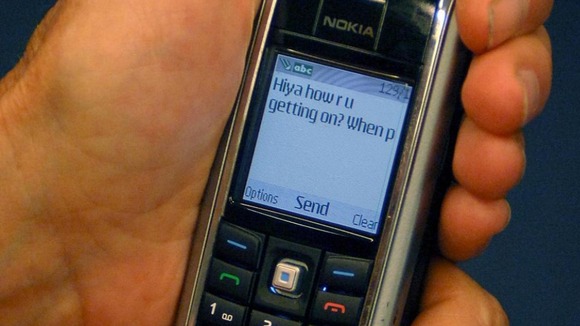
The first off text ever sent, twenty years ago today, said Merry Xmas. Photo: Steve Parsons/PA Wire/Press Association Images
Twenty years since the first off text message was sent, texting is now the most popular way to stay in contact, reported by Ofcom.
The first ever text was sent on December 3 1992, when Neil Papwell, a 22-year-old British engineer used his computer to send the message "Merry Christmas" to an Orbitel 901 cell phone.
According to Ofcom, the average person in the UK now sends 50 text messages every week, but younger teenagers send a lot more than this; 12-15-year-olds send an average of 193 texts every week.
Texting has spawned its own entire language of acronyms, which can confuse. The Prime Minister David Cameron's relationship with former editor of the News of the World Rebekah Brooks was revealed after a number of unseen texts between the pair were published.
Apple and Google creating joint bid for Kodak patents
No comments:
Labels:
NEWS,
TECH WORLD
Apple and Google might be opponents competing for tablet and smartphone customers, but according to a Bloomberg report they have joined forces to acquire Eastman Kodak's 1,000 imaging patents to get more than $500 million. The Wall Street Journal first reported in the possible alliance in August. Previously, the Journal reported that Google and Apple were each leading separate consortiums to buy the patents within the range of $150 million to $250 million.
US: 200 Teenagers Have Been Taken in Afghani War
No comments:
Labels:
NEWS,
WORLD
The U.S. army has taken more than 200 Afghani teenagers who had been taken within the war for around a year at a period at a army prison next to Bagram Airfield in Afghanistan, the United States Of America has told the United Nations.

The U.S. State Department characterized the detainees held since 2008 as "enemy combatants" in a document sent every 4 years to the United Nations in Geneva updating U.S. compliance because of U.N. Convention in the Rights of Child.
The U.S. army had held them "to prevent a combatant from returning to the battlefield," the document said.
A few are still confined during the Detention Facility in Parwan, which will be turned over to the Afghani government, it said. "Nearly all them have been released or transferred to the Afghani government," said the document, distributed this week.
Nearly all of juvenile Afghani detainees were about 16 years of age, but their age was not usually determined until after capture, the U.S. document said.
If the average age is 16, "This means it is highly likely that some children were as young as 14 or 13 years of age when these people were taken by U.S. forces," Jamil Dakwar, director of Our Civil Liberties Union's human rights program, said Friday.
"I've represented children as young as 11 or 12 who possess been at Bagram," said Tina M. Foster, executive director of International Justice Network, which represents adult and juvenile Bagram detainees.
"I question the sheer number of 200, because there are thousands of detainees at Parwan," Foster said Friday. "There are other children whose parents have said these children are under 18 during the time of their capture, and the U.S. doesn't allow the detainees or their families to contest their age."
Dakwar also criticized the length of detention, a year through average, according to the U.S. document.
"This will be an extraordinarily unacceptably long period of time that exposes children in detention to greater risk of physical and mental abuse, especially if these are typically denied access to the protections guaranteed in their eyes under international rule|statute|regulation," Dakwar said.
The U.S. State Department was called for comment in the criticism, and a representative said these people were seeking an officer to reply.
The previous Our document 4 years backwards offered|presented|as long as an overview of focus of U.S. army's effort within the endgame of Bush presidential term after years of warfare and anti-terrorism campaigns. 4 Years Backwards, the U.S. said it held about 500 juveniles in Iraqi detention centers and then had only about 10 during the Bagram Airfield in Afghanistan. A total of some 2,500 youths was indeed taken , almost all in Iraq, from 2002 through 2008 under the Bush administration.
Barack President obama campaigned to get the presidential term 4 years backwards partially through winding down active U.S. involvement within the Iraq War, and shifting the army focus to Afghanistan. The latest figures through under-18 detainees reflect the redeployment of U.S. efforts to Afghanistan.
Because the teen detainees were not charged with any crime, "a detainee would generally not be offered|presented|as long as legal assistance." these people were allowed to attend open hearings and defend themselves, and a personal advocate was assigned to the document, each detainee said.
"These are basically sham proceedings," Foster said. "The personal representatives don't do anything different to get the child detainees than they do to get the adults, and is nothing."
The document added that "the purpose of detention is not punitive but preventative: to prevent a combatant from returning to the battlefield."
It cited a 2004 U.S. Supreme Court case, Hamdi vs. Rumsfeld, as establishing that "the rule|statute|regulation of armed conflict permits the United States Of America to detain belligerents until the end of hostilities without charging such individuals with crimes, because they may not be being held as criminals facing future criminal trial."
"The U.S. army is fighting irregular forces?" Al-Qaida, the Taliban, and an array of similar shadowy insurgent or terrorist groups. So it is not clear when "hostilities" would ever formally end, since there is no declaration of war and no enemy government to defeat. Only the United States Of America can decide when it deems a conflict to be over, in those circumstances.
Foster said that the teens seized are not in uniform or even typically taken in combat.
"We're not discussing about battlefield captures, we're discussing about people who happen to be living at home, and four or five brothers might be taken together. It might take them a year or more to figure out that one of them was younger than 18, to determine the identities among these kids," she said.
Within the State, January Department will send a delegation to Geneva to present the document to the U.N.'s Committee in the Rights of Child, and to response any more questions the U.N. committee members could have.
---
In regard to the Web:
The U.S. State Department document to the U.N. Committee in the Rights of Child:
Subscribe to:
Posts (Atom)


